Inversions
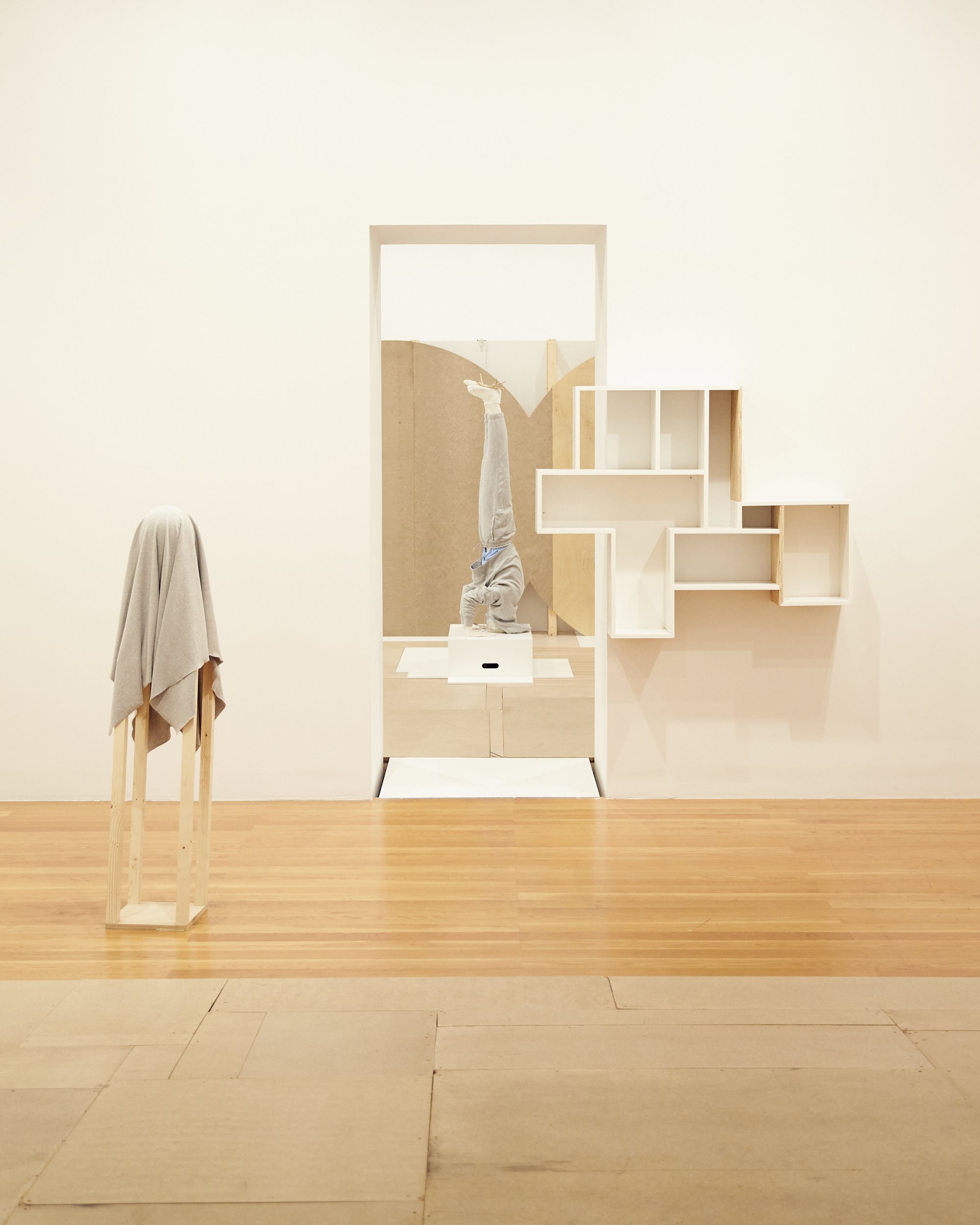
Two inverted figures stand on opposite sides of the gallery on their hands. One holds a flooring panel, or a door or something, into the air with their feet. These figures have me reflecting on fables I tell myself, or my mother tells me, or we tell each other about funny episodes I would have as a kid. Somewhere between awake and asleep I would stand on my head, propped up against the wall in her bedroom in a frantic attempt, I would proclaim, to stop the sky from coming down around us. The pre-newtonian drama of it. I'm not sure it ever happened, maybe once, but the story sticks with me.
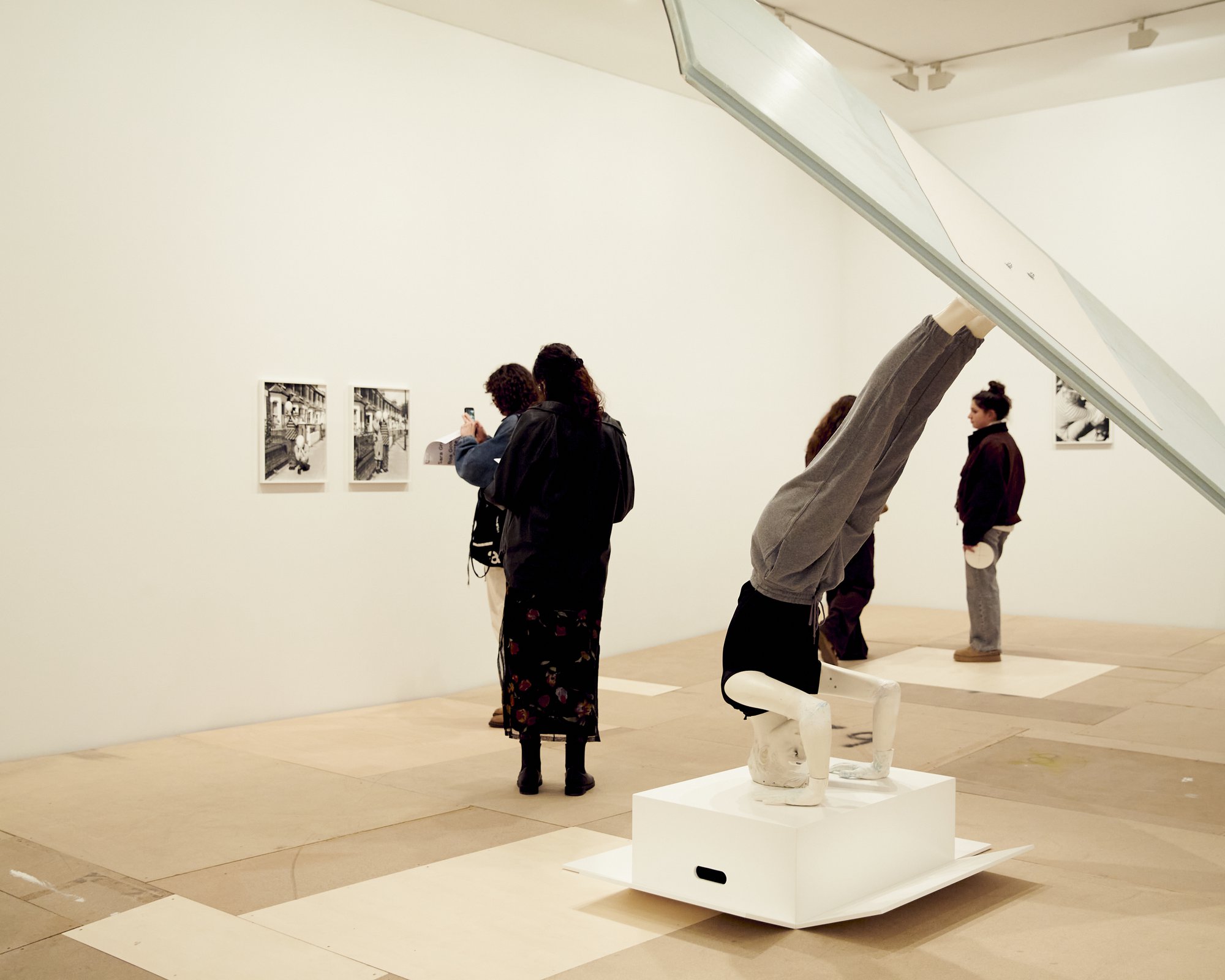
Inversion is a word that means many things in many settings. It papers over tax evasion when deployed in corporate contexts or described, in the not too distant past, homosexual proclivities — a sexual invert. These days, it might most often relate a genre of yoga pose. I think it’s also a recurrent theme in BGSL but then I think more about how, recently, I've been excited by a sensitivity, a specificity, of diction when reading or talking about art. I'm thinking here of Tina M. Campt speaking in an April 2017 E-Flux interview with Arthur Jafa about his film LOVE IS THE MESSAGE, THE MESSAGE IS DEATH and the distinction they make between motion and movement, “Movement means changing the position of an object related to a fixed point in space; the focus is on that space. Motion, on the other hand, is a change in the location or position of an object with respect to time”, Campt says. So, in search of precision, I think a little more and wonder if there is a word that like inversion describes an atypicality, a reversal, but might refer uniquely to the act of turning something inside out. For that is what I start to sense, a surfacing of internal depths. I search for it. Eversion — the action of turning a structure or organ outwards or inside out.
So, these two most figured sculptures remain inverted while elsewhere in the show we encounter eversion.
Eversions
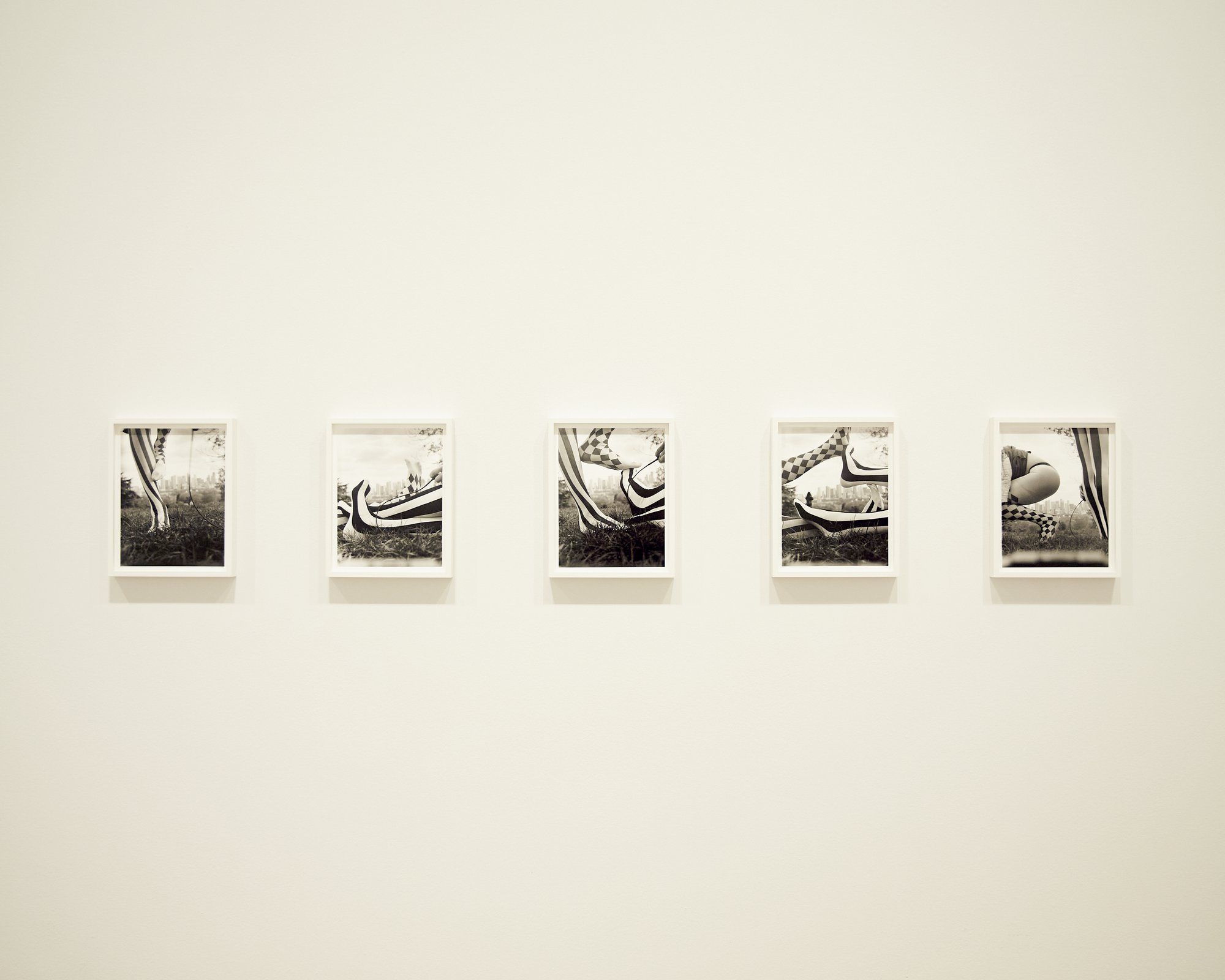
There is a series of five photographs hung in quite close proximity, with ample space either side of the arrangement, so that there could be much more space between each one if desired (this is a cluster), along the back wall of the third room (BGSL is sequential like this) of the gallery.
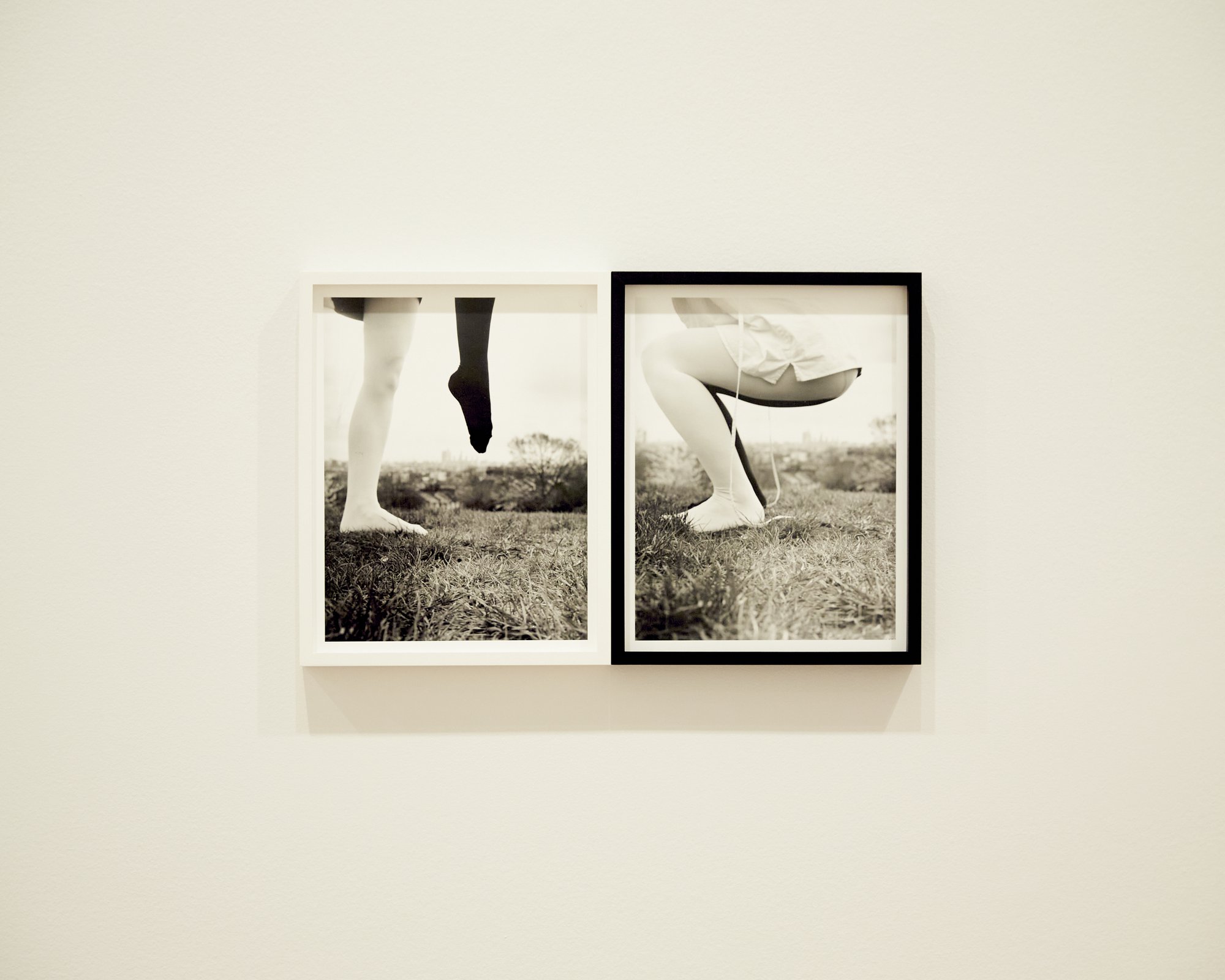
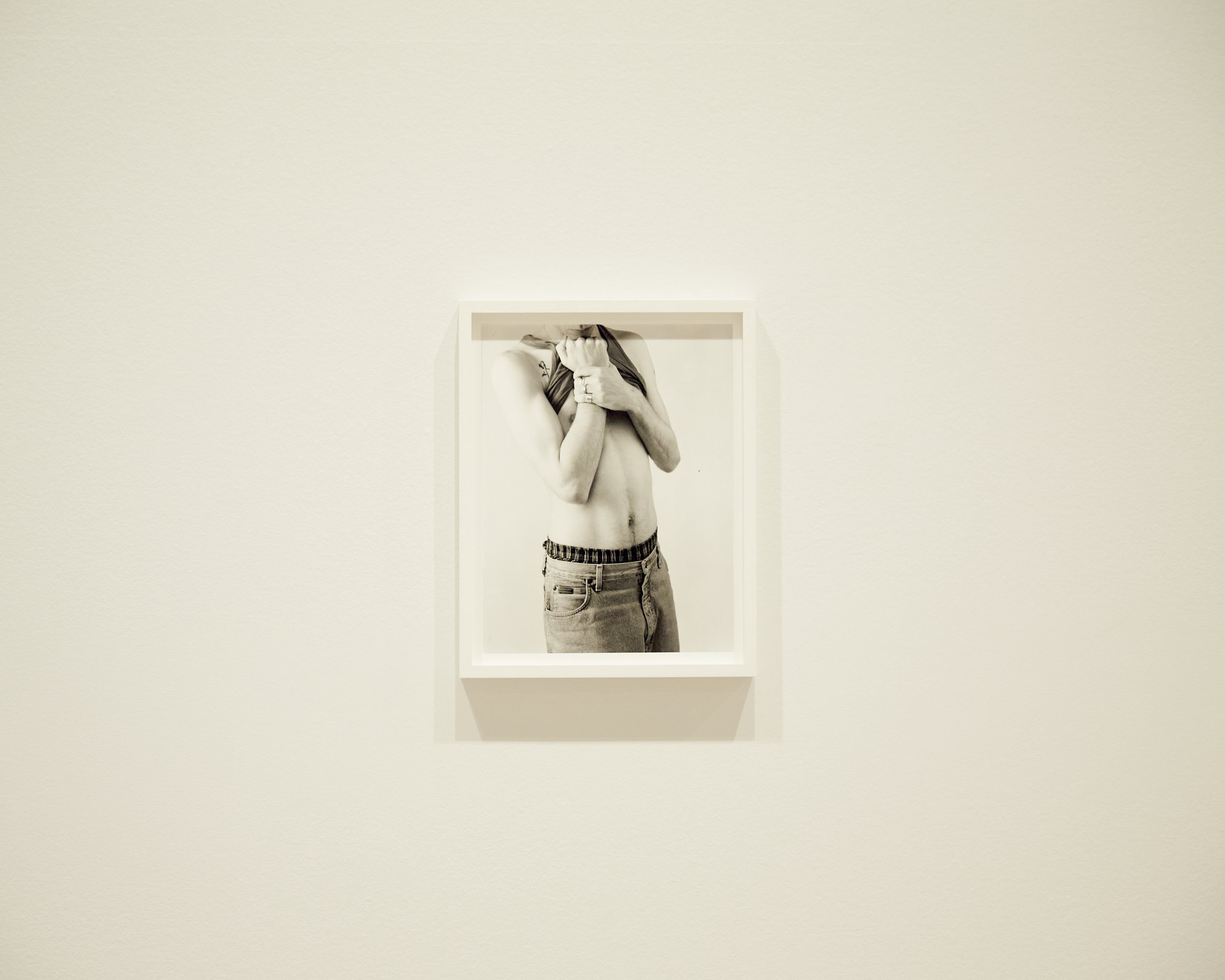
I realised literally only in the last two weeks that I have aphantasia or hypophantasia at least and wonder how much this effects my capacity to describe things with any fidelity, as images of them do not render accurately if at all in my mind’s eye, and, I forgot to take pics so here goes: they are crisp, black and white, close up photographs of legs and feet in stockings or tights that have either a striped or harlequin diamond pattern. No inversions as such but one feels as if these limbs are attempting certain stances, postures, or indeed, poses. They make contact with grass in the foreground of what appears to be a park and are set against the distinct backdrop of London’s cityscape, where Sara lives.
This is not the first time repetitive two tone patterns appear in Sara’s work (see her MFA graduation show from Goldsmiths last year) and for a while I have been curious about why they seem important to her. From my own modest ventures I know that if you go on photoshop and ‘invert’ an image it will flip the colours to their relative opposites. Purple to yellow, green to red etc.
If the image you invert is black and white then what happens is something like an ‘x-ray filter’ akin to the ones you could find on old iPhone apps that mimic film negatives, giving one the impression they are seeing through the surface of the thing in question. Inversions in black and white become eversions — less of a colour swap and more of a making light dark and dark, light. However, in this B/W photo series, in the uniform repetitions of stripes and diamonds, echoed in the insistence of buildings reaching into the sky behind them, it becomes unclear what is the negative and what is the positive, so to speak.
Two tone patterns in Sara’s work, their eversion effect in the images they appear in, create a slippage between inside and outside, a slippage between surface and interior. The fact that the photos are set against the motif of the city makes me think of how a being in the city is both a being within and a being without. A being simultaneously immersed entirely in its totality and then almost completely excluded from the spaces therein, either because they are ‘private’, or simply because there are far too many for one person to possibly visit.
In the city, where do surfaces end and where do they begin? You are not in the city, you are the city.
This slippage is elaborated on in another moment in the show in which a large, pink and black striped fabric is stretched over, on one end, a spherical bulge, is pulled through a small hole in one of the exhibition walls, and emerges again to support an unstable column leaning over precariously in counterbalance. The stripes appear to be the only thing keeping this hastily assembled construction together. Facade surfaces as infrastructure. The pattern essential.
<3
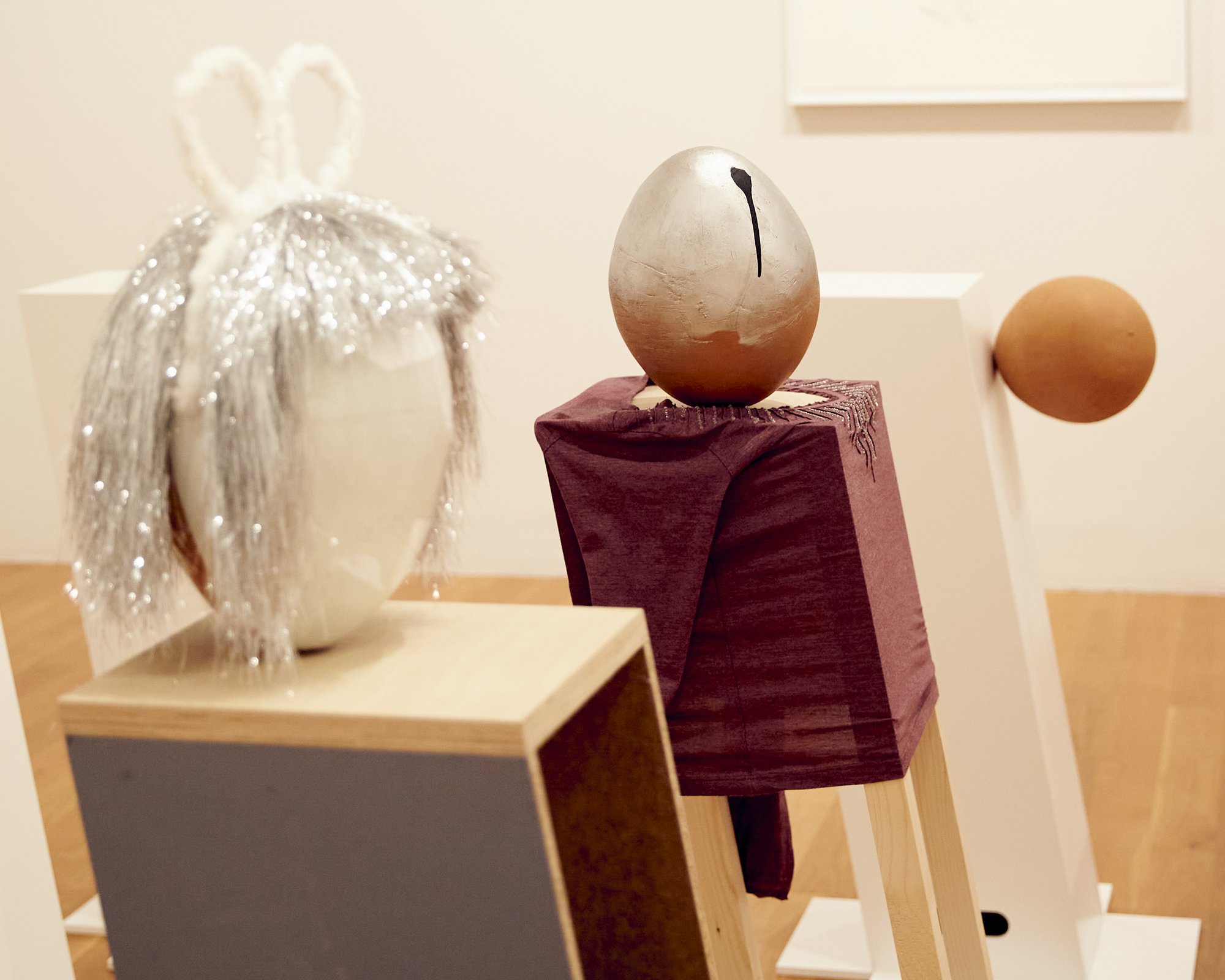
I've gotten this far and haven’t mentioned a lot of the things in the show that make it what it is. The first room we enter is packed with a gaggle of pedestals askew to about 60 degrees, each with an egg atop, within, or astride it. They are dressed up to various extents: tinsel hair, bunny ears, spray paint. Collectively they are a flash mob who, having assembled, pause momentarily before beginning their performance. They are what we meet first in this show — they are pregnant, poorly-disguised, cheeky — a primer for the timbre of work we will continue to encounter.
There are more photographs, too. They don’t appear in such distinct clusters as the ones previously described. This time in suburban settings. The figures in them come in familiar stripes, wearing or holding egg-shaped masks in-front of their faces, connecting the pedestal figures in the first room to the people (?) we see here. There’s a strange sense of subjecthood to the figures in these photographs. They are affected with just a minor absurdity. They threaten the biographic but are tinged with the cartoon. Are these people or are these characters? This is a question for me. The stripes and masks situate the figures within the world of BGSL and its binding principles while distancing them from portraiture and/or still life but, unlike the other posing bodies, they are unbothered and unanimated by the camera.
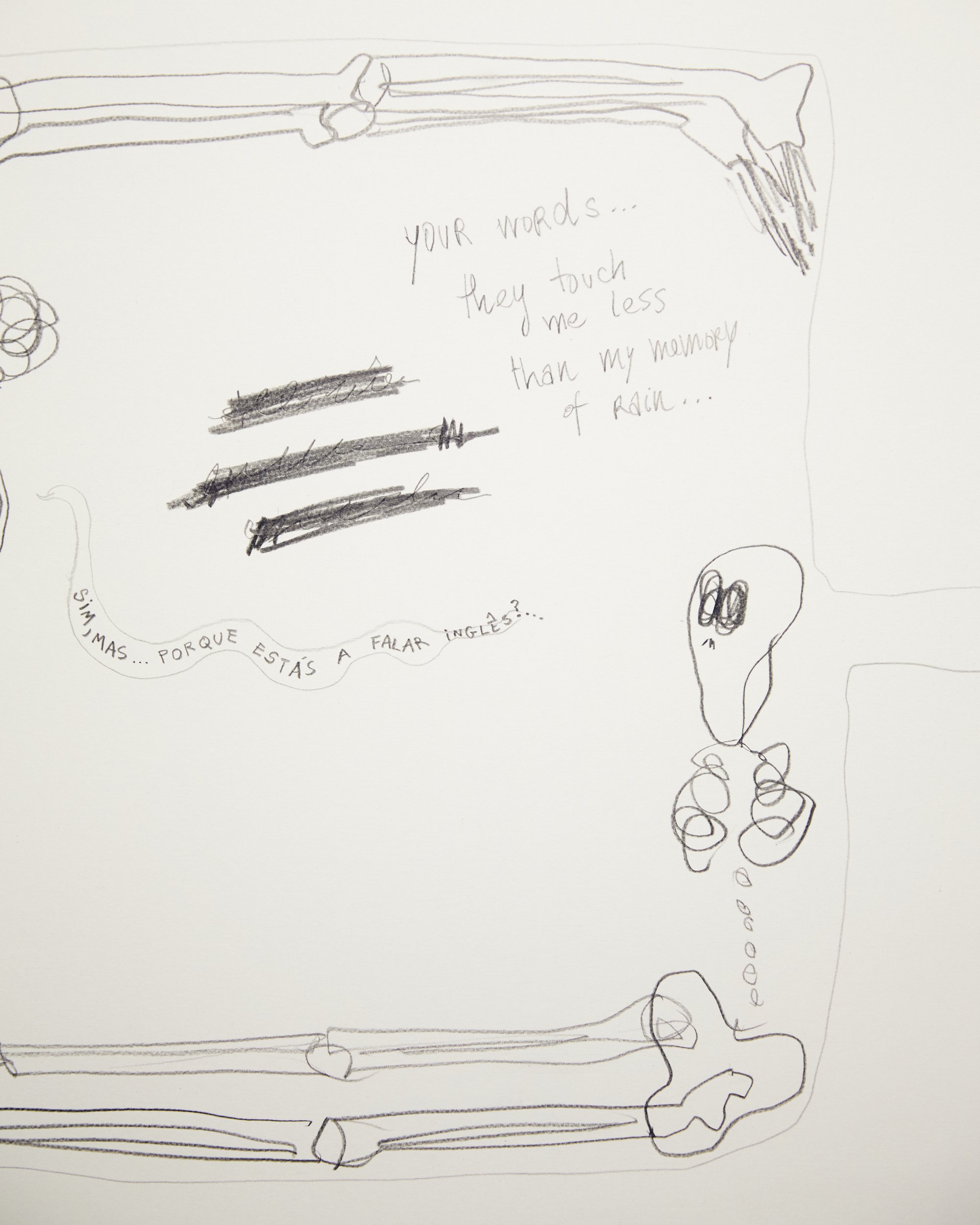
Drawings on the walls, about one to each room, depict skeletons cramped within a snake’s belly in familiar vignettes of a renter’s domestic life. The skeletal forms are important. They are comical and morbid, like skeletons do be, and show the effects of the domestic on the body — the twists and turns put on us as we hunker down inside the often entirely incidental dwellings we make our homes. But the skeletons are also great vessels to play out the quotidian interactions of what it’s like to co-inhabit. In one snake’s belly, one skeleton tells the others “I think I’m moving out”. In another, one asks“does your boyfriend have keys now?”In two more a couple stares incredulously at decorative items on the wall, items they live amongst but have no relationship to; a peace sign, a Beatles album cover. In yet another, as a skeleton's knees press up against their chest and their head is pressed down toward their knees by the constricting walls, words spill down out of their mouth “não olhem para mim…” (don’t look at me…).It’s funny and it’s sad. It’s beautiful and it’s sad. Privacy is a luxury. Space is a privilege. But what happens when you don't have it can make for joyous moments too. The indistinctness of the skeletons make something clear: habitation is a condition we have far from perfected. The city is a mess. I don’t know these skeletons but they are my own.
#36 | Sara Graça | "Boa Good Sorte Luck" | 2025
Related Events
About Sara Graça
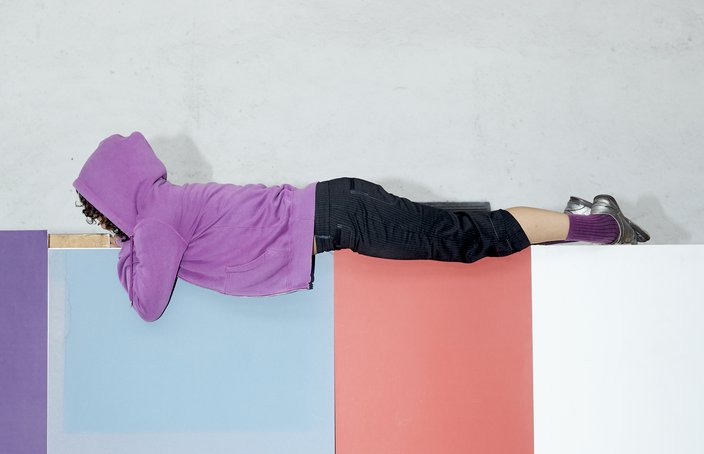
With a practice that unfolds across a wide range of media and artistic disciplines, Sara Graça's career defies categorisation, embracing unexpected twists and turns and renewing itself with each new work, project or series. However, there is a tendency in her work towards materials and peripheral states: towards things, instances or situations that we often discard because they appear marginal or escape the utilitarian rhetoric that governs our daily lives. Nevertheless, many of her works seem strangely familiar to us. They refer, more or less directly, to references and circumstances that we find in our daily lives, but seem to require their own code, another syntax, to process and describe them. Sara Graça completed an MFA at Goldsmiths, London, in 2024 and her work was included in the latest edition of New Contemporaries, the most renowned British event dedicated to emerging artists.
TEAM SHEET
TEXT
Cameron Lynch
EDITION
Carolina Luz
CONTENT REVIEW
Catarina Medina
DESIGN AND WEBSITE
Studio Macedo Cannatà & Queo