

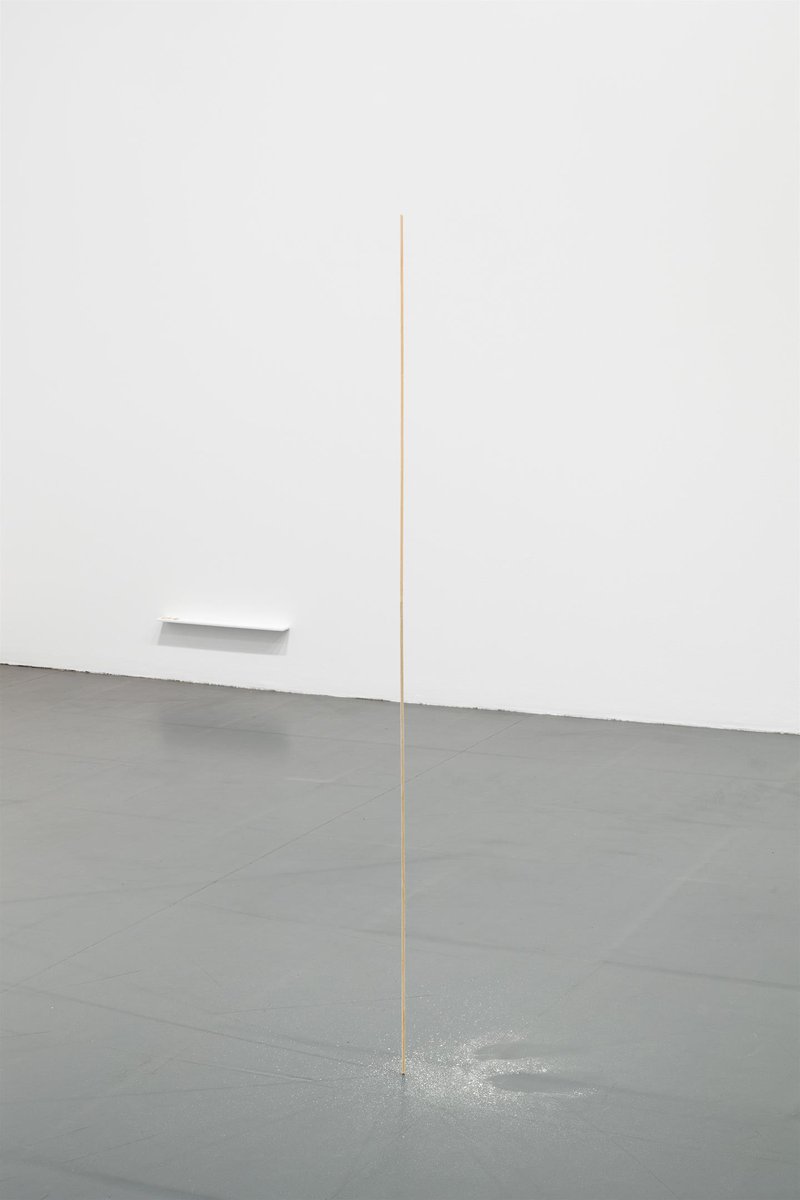
regardless of its nature, an exhibition always takes place beyond the opening hours of the space in which it is displayed. we may estimate the number of days the installation team has devoted to it, paying attention to the technical specificities of each piece, yet the work of “preparation” is by no means exhausted by the procedures that precede a vernissage. there are those who will take it up from that point on. other hands under one and the same purpose. before the museum even opens, the first hands have already been dirtied in service of the exhibition. those of the people tasked with cleaning the rooms. and those who sand the top of the balsa wood rod that Armanda Duarte had installed, at her own height, back in two thousand and twelve. a preliminary and invisible task, then carried out by the artist herself: subtracting that whole – head, torso and limbs – between the opening and closing of the group show Logradouro, at Espaço Avenida 211, by sanding the upper end of the extremely slender balsa wood rod that someone [herself?] had driven between the floorboards of A Room of One’s Own. a room of her own until the moment it opened to the public.
not exactly a self-portrait, although based on Armanda Duarte’s height as its reference measure. nor a performance, even if performative in character. a ritual-work. one that operates in reverse, perhaps under the precept of “decreation” and thus in line with Simone Weil: “[t]o undo the creature in us” through artistic practice, here enacted through the “subtractive effect” of sanding. diligently undone in the unmaking of a counter-monument. conceived within a horizontalising project and “sabotaging the verticality of sculpture, [which Aline Dias identifies as a prominent] characteristic of monumental space” as asserted in the pages of our thickest textbooks. [a body-to-body struggle with that capital, ever-so-masculine Art History.] shortly before the doors open, the person responsible for performing the task – in the role of Armanda Duarte and more or less at her height – will arrive to “undo a column” half a centimetre in diameter. with each new pass, a small segment will have yielded to friction. capital, shaft, base. everything turned to dust. reversing the established order and other phallic refrains.
it is through the “lacunar survival of the event” that the work constitutes itself as such. we may perceive it through the echoes of Judith Butler and from there delve even deeper: for it is not only the balsa wood rod that crumbles, but also a “self” that we have mistakenly – and often celebratorily – assumed to be separated from its surroundings. from the surrounding dust arises the unmaking of this laborious and prolonged “writing of the self.” a column made lacuna under the “intense labour” of one who inscribes herself, already on her knees, through the contours of her presence. in the words of Lígia Afonso, the “seemingly unproductive, silent, discreet result” that the artist offers us – even when relinquishing the role of executor – ultimately pours forth as a testimonial-work. between 3 Elementos no azul and a handful of Jotas, we find it at the Águeda Arts Centre, where the Caixa Geral de Depósitos Collection presents Joga o Jogo. part of the “third and final section” of an exhibition cycle curated by Hugo Dinis, it is a work in permanent disintegration. everything is set: that whole and all that will disintegrate over the coming months as the somewhat “random and senseless” correspondences of an intricate Fugida! unfold along the “paths” of what is yet to come.
Carolina Machado
0,5 x 172 x 0,5 cm; 172cm – altura da executante; folha branca de lixa-de-madeira, cortada e dobrada (2 x 3 cm)
Inv.574142