

in the course of the first semester of two thousand and three, the Modern Art Centre of the Calouste Gulbenkian Foundation was venturing into staging a “decisive” storm. the very one that Francisco Tropa had conceived, in balsa wood, the previous year. so it appeared on the cover of the exhibition journal: a storm rendered to scale, still awaiting its mise-en-scène. in a solo show curated by Jorge Molder, the artist invited us to stage it on the institution’s first floor. [as always, a task shared between those who create and those who experience. after all, the “reason for things” has never been anything but “to give you work” and to make you experience by creating.] the layout proposed there seemed to evoke the architecture of a multifamily residential building. perhaps Parisian, if we follow – as Andreia Nogueira does in the aforementioned dissertation – the episode recounted by the artist regarding the “origin” of the work of art. of this work of art in particular. according to Francisco Tropa, the installation L’Orage would recall “the fall of scaffolding in Paris [an image he encountered] after a storm.” thus we may understand the “association” between his work and that of Georges Perec. more specifically, the already-discussed correspondence with Things or Life: A User’s Manual.
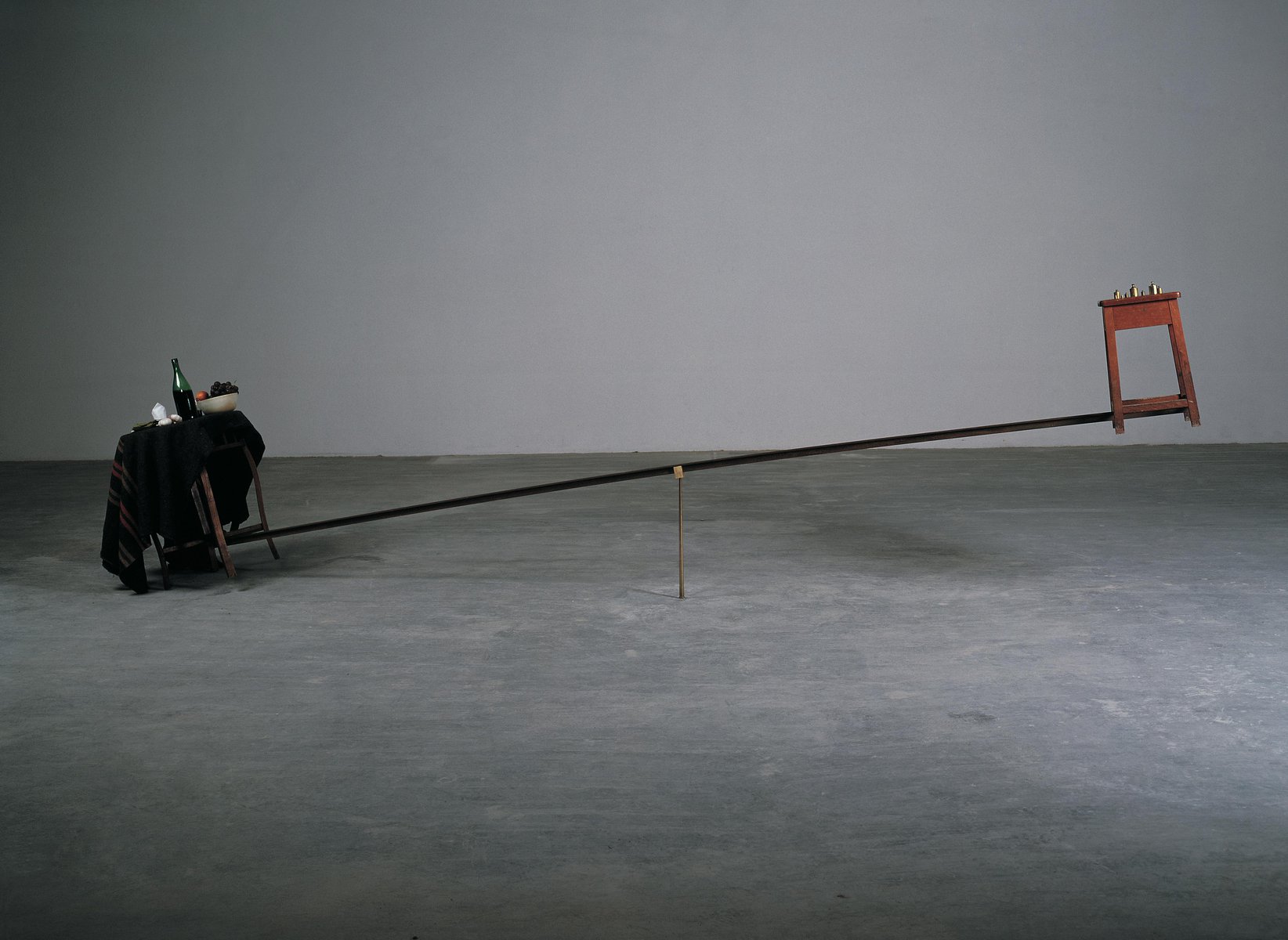
assuming Delfim Sardo’s reading of the metaphorical potential of Francisco Tropa’s work, we might unfold that “endless web of interpretation in search of meaning” by inferring a downward direction. the unstable structure, arranged with millimetric precision on the ground floor of that hypothetical building, questioned the “human condition” under a “frustrated attempt to escape gravity.” perhaps the “fall as [inherent and ever-imminent] human destiny.” hence the “fall into sin” or the frequent yielding to our most mundane appetites. [how not to yield when everything sharpens our hunger for abundance?] upon us – and upon this table – lies the burden of an urge never fully satisfied. against all odds. according to the description proposed in the inventory for the piece Une table qui aiguisera votre appétit – le poids poli, conceived beyond the inaugural storm and aligned with the artist’s remarks on the “autonomy” of the parts, it is something like the materialisation of an “abundance [so] desirable” as it is unachievable. more than that: it leaves only desire in its wake. acquired from the Quadrado Azul Gallery by the Caixa Geral de Depósitos Collection, since taken as “autonomous” by the artist himself, this other “entity” constitutes a “puzzle” to be digested “over time.” that is to say – never fully saying, very much in the manner of its creator – that the “game” never ends and no sip ever satisfies.
since his time at the Royal College of Art, Francisco Tropa had nurtured a certain fascination with “scientific objects [rendered] obsolete and anachronistic” by the accelerating process of technological “obsolescence.” in his dissertation, Filippo De Tomasi portrays an artist captivated by the uselessness of “disused apparatuses,” subverting their initial “scientific function” and “making them, in some way, even more useless.” like the eight weights he arranged – methodically yet in vain – upon the small bench affixed to one end of this iron rod, pulled down on the opposite side by the triumph of craving. at the top of a bronze spike, the rod and all certainties falter. the laid table weighs upon us, supposedly ready to satisfy our appetites. it will only sharpen them. not least our curiosity. [what justifies the declared polish of one – and only one – of the eight weights?] uselessly it lies there, like the other seven, the lustrous number two. its first purpose is fulfilled: “to give you work” by fuelling any number of theories. theoretically impossible, it stands as yet another of the “reaction machines” the artist offers us to decipher, guided by clues that methodically lend themselves to the most elaborate flights of fancy, among the many “visual devices and reflections on looking” that leave viewers wandering.
exhibiting the “intentionally erratic combinatory method” identified in the inventory as a defining feature of Francisco Tropa’s production, the still life now held and decaying in Óbidos – until the fifteenth of February, on loan to the NovaOgiva Gallery – “is the hook that wounds death,/that wrestles with it, leaves a trace,/a syllabary to be reconstructed” in the context of the third exhibition in a cycle resting on this final verse by Luís Quintais. integrated into the commemorative programme Óbidos, 10 Years as a UNESCO Creative City of Literature, the exhibition sprouts “from the literary universe” to offer us this striking installation as a place of “transit between the visible and the sayable” of things. decomposed beyond the syllabic, theatrically engineered against the elemental forces of nature. in any case, nothing by chance. pure, blunt systematics. under a curatorial project by José Maçãs de Carvalho and Inês Pinto Faria, this “complex scenic device” of absurd precision now plays itself out on Rua Direita, rekindling a “utopia significantly constructed in the first-person plural” more than half a century ago, when that very first desire was being sharpened between clenched teeth.
Carolina Machado
146,5 x 485 x 83 cm
Inv. 593443